Methodology for Robot-Driven Artificial General Intelligence

Training computers on 2D images and what can be found online is cheap and convenient, but it is not how a human learns and in my opinion not part of what will achieve AGI.

We need to emulate a human as much as possible, with an android robot, and let it try/fail/learn in the real world, to achieve what humans do. In 3D, like humans do.

Uniformity and Mass Adoption

There needs to be a lot of robots, because the more we have, the quicker they can learn collectively. 10,000 is a starting guess.

For the SMAL described below, the robots need to be highly consistent, physically, for the whole duration, possibly decades. That means waiting until robots of the required specifications can be made in bulk (battery and fine mechanics will be key), making a lot of them, and never upgrading them if that at all changes their physical dimensions, including weight and weight distribution.

Hive Mind

Having 10,000 robots means that in one day of 10,000 attempt the same task, but in different environments, then they will collectively have enough knowledge to nail it in the future.

They will share knowledge, especially of objects they encounter in the world, and how those objects (including machines and people) tend to operate.

Training

Aside from some fundamentals which can be hard-coded, the robots begin their training from small children who are at age where they can talk and play and teach. Perhaps starting at age 3. The robots will operate with a vocabulary that fits who they are interacting with.

At age 3, all the robots will do is play with the child, with everything led by the child. Not dissimilar to how a child plays with toys and dolls, except they can tell the robot what to do, and it will try.

The robot will also observe and attempt to mimic what the child does, and the child knows that is what is happening, that it is trying to learn to be a person. After attempting to mimic something, the child will tell the robot if it succeeded or not, and what it got right or wrong, especially the latter.

SMAL

Once the attempt to mimic is completed, the robot will store the details. This will require a custom-made programming language, which stores details of the environment, what it observed, and the actions taken when attempting to mimic them.

Scaled Memory of Actions Language (SMAL) is called scaled because scaling things is easier, more efficient, and easier for AI to work with. For example, the speed the robot moved at can be described as part of a scale from 1 to 10, where say 4 is anywhere between 3 and 4 kms per hour. Things like lighting, time of day, how crowded it was, how it thinks it was feeling (pressured, for example), and the relative distances of all the relevant objects are from it, can be captured in scale form.

I moved at speed 3, in direction 22, my arms were in position 4 and 8, visibility was 6, I felt a 2 of pressure to perform, and the cat was a distance of 7 away. After 4 seconds I was closer to the cat which was at distance 6 now.

After the attempt, the child or instructor will tell them what was a key factor in what they did wrong. AI can later spot factors that might not have been explained, like failure happening more in poor visibility.

Enter AI

Then we add AI, similar to the chatbots of 2023, to the mix. That type of programming is good for coming up with an averaged, approximate response based on thousands of reports, separated into success and failure. Once learned sufficiently, a robot should be able to achieve a task, according to the environment, based on the collective past efforts.

Types of learning

It’s unlimited, but primarily will be the same as what children do and learn every day. They move around and interact, try their best, fail sometimes, and learn.

Graduating

After spending sufficient time, collectively at one year of childhood (years are approximate, children mature at different rates, one year increments should be fine), they all move to the next year, with the same child or someone new.

Once they reach adulthood, half of the robots are no longer needed. They know enough about the 3D aspects of the world to switch in AR, and be built into AR spectacles. Those ones observe and ask questions. Who is that? Why did you respond like that? There will still need to be many robots that are physical, to properly interact with the world, but at that stage they can take any form, they no longer need to be all the same dimensions. They will still need to learn some physicality, primarily things like hugs and shaking hands, and all the subtleties within.

Posted in AI

AI Beats the Stock Market and Rules the World

“Stockmarket Charts” by Negative Space/ CC0 1.0

People have been using computers to try and beat the stockmarket/sharemarket ever since computers existed. And for the most part they have failed. Certainly anyone who had an advantage has not been able to keep it secret, or stop others working it out. So we get told that AI cannot win at stock picking.

But that is when computers only look at the technicals – price movements and ratios and the like – pure numbers. The same can be said for the forex markets. People who do (supposedly) profit from these via skill are not numbers people – they research and use instinct and are cautioius.

Generative AI has quickly moved into the areas of words, images, video and even sound. These are not primarily mathematical, but the AI can be trained to spot patterns and make predictions. If it knows my writing, it can predict how I will finish a sentence. Of course it isn’t prescient, but an educated guess is all a stock-picker can make anyway.

Stock movements are triggered by all sorts of things. The layman in me knows of at lease these:

  • Company announcements
  • Economic indicators
  • News affecting sectors
  • Currency movements
  • Rumors
  • Boredom (stock is static and something else is shinier)
  • Re-balancing of funds – especially the top 50 type

There will be more, of course. The thing is, all of this, combined with the technicals, is knowable by AI, and patterns can be found. Analysts might know that a CEO being accused of anything sexually improper will definitely make a share price drop. But by how much, how do you weight such news? And what decides if the stock price recovers or not, later?

I predict that an AI system will one day be able to make stock picks based on news combined with fundamentals, enough to beat the market.

My only doubts are:

  • How much better can it be than humans?
  • How long will it take?

Could be that it needs 1,000 years of data. Or 10. No way of knowing until you try.

When and if it happens, the degree of improvement in results over human analysts might not need to be much at all. Once you have certainty in the level of good predictions it can make, then the bets can be ramped up using financial leveraging, whether that is borrowing money cheaper that the returns you will get, or trading in derivatives.

Then, if nobody else has access to such a tool, the owners (or even the AI masquerading as the owner) can very rapidly become the richest entity in the world, and then some – with all the power that brings with it.

The Return of Sponsorship

Soap Operas were named after being sponsored by a soap company. One company instead of a variety of ads.

ChatGPT etc will spawn an answer service (as distinct from a search engine). It might only happen when we fully understand what it can give accurate answers to. Quite possibly it outputs answers and ideas to explore. The latter being a fancy way of saying it is not confident of being correct.

People will learn what an answer service is good for. It won’t be for finding a local plumber! Which means the types of ads we see in search engines won’t necessarily apply.

If you want a summary of the best features of an iPhone, then perhaps the ads we are used to seeing on Google can appear there. But I expect it would be more like this:

  • Sponsored ad at the top, from a sponsor – one advertiser who sponsors all queries of that type. For example, an electronics store could sponsor all tech queries.
  • Embedded affiliate links to products – possibly a link to something akin to Google Shopping
  • A list of suggested resources, commercial or otherwise, at the bottom
  • Below those resources, some contextual ads, like on Google Search. Yep, relegated to the bottom, but still existing because why not.

But the sponsorship will be new and lucrative. All requests for the system to conjure up imagined lyrics can be sponsored by Spotify. All generative images by Adobe. And so on.

It could become new/fresh/different enough to become a successful form of advertising. We might see the return of soaps sponsoring TV shows.

Passenger CoPilot Device for Cars

AR glasses will come, but it is taking forever, so I thought about intermediate technology that might help it become real.

Imagine this:

A detachable large tablet for the front passenger of a car. It will not work unless attached to a special hinge which ensures that the driver will be unable to view the screen.

The screen shows the same view as the windscreen, but with AR elements overlayed.

The copilot then does what they have often done historically with paper maps. They help the driver. Useful for these scenarios:

  • Finding the house/building that is their destination
  • Finding out where the closest gas station is – or charging station
  • Checking alternate routes
  • Getting info on business and places that they are driving past – that restaurant has a lunch deal!
  • Ordering something before arriving

Why it works:

  • Technology already exists, and could be quite cheap
  • Avoids the dangers of similar in a HUD for drivers
  • Unique selling point for the car brands who offer it
  • A low-commitment entry into the AR space for Apple, Alphabet or Meta

It could also be used for audio playlists, car data, adjusting air conditioning, games, movies (with bluetooth headphones) – the latter uses for back seat passengers with a screen built into the back of the front seats.

Being built in is good for safety.

AI and Private Data Training

For conversational AI, there are many contenders for winner, and probably there will be a winner who rules all, because they are all being trained on public data (the Internet).

For using AI to create images in Photoshop, or spreadsheets in Office, they already have monopolies, and those abilities will simply cement the monopolies further.

But there is a world of potential uses that need to be trained on private data, and that will help one AI business rise to the top. First mover advantage from training on private data.

Example:

In business meetings with client I often need to recall data to respond to a question. It is far better for me to know it off the top of my head, than “excuse me while I look for it”. AI can listen the conversation, and based on its learning, know which data to surface for me, and present it on my screen or AI spectacles.

That takes training. A company like Zoom could (with permission) listen in on meetings and get a head start.

Don’t be surprised if Microsoft wins. They already have Office and Teams. They already have OpenAI. And they can easily buy the companies who can access the private data for training.

Google doesn’t have the same potential for data access. Far fewer people use their platforms for meetings.

The other angle is hardware. If Apple can get their AR glasses out there en masse in businesses, those glasses can listen in (with permission) and learn.

Amazon won’t even partake, thankfully. But they will go after home automation (a talking house), but never be sufficiently innovative to own that space, and hopefully do not buy the winner.

Augmented Reality and Supermarkets

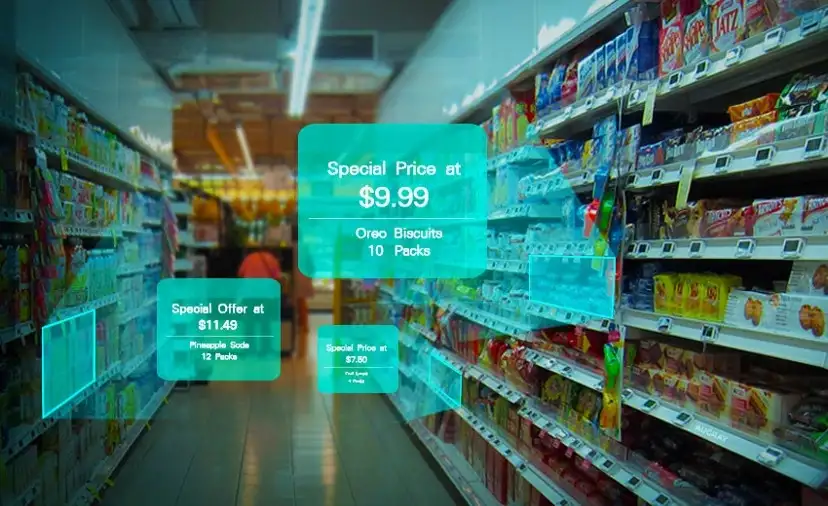
So I came across this image and it got me thinking. I belong to several supermarket loyalty programs, something they are quite good at is remembering products I have bought and telling me (in emails) when they are on sale (on special as we say in Australia).

So, forget about fridge apps, and online ordering. I’m thinking purely of an enhancement to what I already do as an in-person supermarket shopper who uses their loyalty program.

It works best if you only use one supermarket…

  1. Open the loyalty app
  2. Photograph the box or barcode of a product that you had bought and just used
  3. Speak your opinion – Growly likes this dog food

In a multi-person household, or even if you are scatter-brained and single… it means that you have a system that remembers which brands you like, or dislike. Per person.

So not only does your emails about sale items become more enhanced (things you prefer, not just things you bought), your AR experience in the supermarket can be awesome. The AR glasses and show you, like the image above, the products you like and where they are. For example, Oliver’s favourite muesli bars, or Maria’s preferred variety of apple. You could walk down every aisle and let the AR do most of the thinking for you. Faster and fewer mistakes that get you yelled at when you return home.

Closial: Slow, Real, Local Social

Something lacking in social media is the ability to follow people or see posts based on how close they are to your location.

  • Real News – by joining forces with local news media, the sort that only has 10 or less stories per day
  • Local Organisations – like local government announcements, and elected officials can have verified accounts
  • Local Sports – we can offer league tables etc for local and youth sports comps
  • Local Weather
  • Local Radio/TV – quick, easy access
  • Local Users – anyone can join, but they must nominate a location in the local area (it need not be your home)
  • Prioritising Local Posts – the closer to you physically, the more prominent the post/story. Like a burst waterpipe on your street
  • Crime/Safety – discussions and the ability to directly report anything – like potholes or stray dogs – to the appropriate people
  • Marketplace – garage sales etc

Self-moderating via Real accounts

This is important, because moderation is a huge cost for social networks. All users must use their real names, and consequently any borderline illegal behaviour is unlikely

Ads only from local business. Perhaps sections are sponsored by, a week at a time.

The No ID Option in a Digital ID Nation

Here in Australia we have a general fear of a “one ID to rule them all”, and instead we have a hodge podge of pseudo national IDs – Medicare card, passport, driver’s license, which combined get us the 100 points of ID we need. Kinda painful to achieve the same thing, with all the same drawbacks.

When a One ID comes along, there will be backlash from many, especially the sovereign citizen / anti-vax types. So perhaps we could appease them with the option of opting-out?

If we go way back to where being identified was first needed, it was for taxation. And it still revolves around that. Without taxation, nations fail.

We can look at how backpackers are treated, and come up with a similar option for residents who want to be without an ID.

Reduced pay – you can be employed, without ID, but the pay rate will be discounted to what the after-tax amount would be for anyone with ID.

Can’t get married officially – most of us don’t now anyway…

Can’t travel overseas – no passport

They do get the same public schooling and healthcare – because they are effectively paying tax, and they are still living in our country

No driver’s license – but when self-driving cars arrive, it won’t be needed

Cannot be a company director, or operate a tax-paying business – but that leaves plenty of self-employment possibilities

And guess what – aside from taxes (all you need is a birth certificate to get a TaxFile number), all of the above can already be achieved with just a birth certificate.

We still need to provide a path to ID, for when they come to their senses. So people will still have birth certificates. And their babies will as well, that is non-negotiable, they can’t assign their anarchy to their children as well.

So, unless the anti-people want to fight for no birth certificate, this is currently not an issue.

Posted in Gov

Reddit can be the Next Twitter

Reddit already has everything in place that you need to replace Twitter. Actually, it is better than Twitter in all of these ways:

  • Self-moderation
  • Variety of post types
  • Better structure for discussions
  • Premium membership for $6/mo
  • Smarter crowd?

You can follow people on Reddit, so all they need to make it work as a Twitter-replacement as well is:

  • Short form posts than can be filtered for
  • User home pages that are their own communities (already exists, post to your profile)

In fact, anyone can make their own community. Famous people can “blue tick” themselves by simply linking to it from somewhere else they are verified. And short posts are already do-able.

Reddit can make this happen. The amount of coding is minimal, and they would get enough new users to get the valuations and users for an IPO that they are planning anyway.

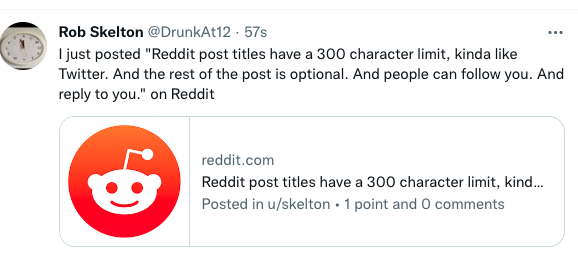
You can post on Reddit and have it automatically share in on Twitter. It doesn’t look amazing, but you can use the Reddit title to be your “tweet”.