
Reducing Conspiracy Theories with Truth Panels

As we have seen with 5G and COVID, conspiracy theories are running rampant in society, and now they are directly causing vandalism, civil disobedience, a few murders and making it much harder to stem the pandemic.

  • We can’t stop social media
  • We can’t remove freedom of speech
  • Conspiracy folk don’t trust/believe what governments say

It will most likely get worse. In a nutshell, people who lack importance, usefulness or acknowledgement in their lives have found something where they can feel correct and important, no matter how crazy that thing may be.

It doesn’t help that, while decades ago research meant hours in a library, today it means I saw some random YouTube video…

We have fact checkers out there… but they don’t change the minds of those who spread rumours and lies. Those people will say you can’t trust Mainstream Media (thanks, Trump, you selfish idiot) and that Snopes is owned by [insert evil billionaire here].

Truth Panel

Find a selection of people, from all walks of life and demographics, who aren’t stupid. The more the merrier – 100 would be perfect, good for percentages.

The initial panel will be decided by 5 founding panel members who are behind the idea – these need to be highly-respected people! After the first year, nominations and online votes can be made in the future to decide who is on the panel.

They cannot be

  • politicians or have any political allegiance beyond simple membership
  • business people, unless they only operate in one clearly defined industry
  • influenced by another country
  • closely related to, or connected with, the above

Ideally they are well-respected in the community, the sorts of people who get honours from the Queen. Many should be actors, musicians or sports people. There needs to be good amounts of medical and scientific and education people. Surgeons, inventors and professors.

They are unpaid.

For the most worrisome conspiracy theories, so perhaps just 2-3 per years, the panel convenes to receive submissions. Anyone in the country is encouraged to submit, and this needs to be well publicised. However there must be barriers, so that effort is required. All claims made in a submission need references (they can refer to any source, even YouTube, but must have a reference). Submissions cannot be anonymous. The panel might have questions for those who make submissions.

After reading submissions, attending debates, and having meetings, the panel will make a conclusion. Typically it would be like this:

82% say the claim is false
8% say it is false, except for some aspect
5% say it is true except for some aspect
3% had a conflict of interest and could not participate
2% say the claim is true

Each panel member writes a paragraph or two in their own words to sum up their findings.

Funding

Funding should be from the government, mainstream media, business councils, unions – anyone who can add some cash. It doesn’t matter who it is, because the panel are unpaid. We just need a broad mix of funding from across society.

Publicity

Unions, charities, political movements can all publicise directly to their members at no cost. MSM can provide some free advertising. State broadcasters can host debates.

Why it will work

Anywhere rumours and lies are spread, they can be countered by a mention of or link to the Truth Panel decision. The panel is, by design, hard to deny. People won’t be able to find reasons for not trusting them. It will be an easy way to shut people up.
Note: countering rumours was important during World War 2

Find/Found – A Fun Dating App?

With this app, there are very few settings. You can choose the demographics of the type of person you seek. And you allow Location.

Oh, and you choose if you want to find someone, or be found.

To be found, just turn on the app whenever you wish.

To find, turn on the app, it has a map. No, it doesn’t. It gives you two numbers – the total of people in your chosen demographic who wish to be found, who are within 1,000 metres, and 50 metres.

That’s it. You won’t know who they are or precisely where they are. If it is a crowded 50 metres, it could be anyone. If it is a forest, it might be just that one person over there.

Purpose: facilitates and adds mystery and adventure
Price: zero

Cute Park Wardens

Could apply to other public spaces…

Going forward, social distancing in parks might be something we feel should be policed.

What if it could be done in a cute and friendly manner?

Maybe tell people off for smoking, drinking or not picking up dog poop…

A robot animal that is Hello Kitty level cute. If social groups are too close to each other, it trundles over and gently nudges them in the direction of away from each other.

When it sees an infraction, it comes over and just shakes its head and softly says nuh-ah!

Simply being targeted by the cure creature will be enough for most people to conform. Otherwise, of course, community cops will turn up sooner or later.

It would work in tandem with overhead cameras and AI.

Bedroom Cams for Rape Evidence

blurry

Rape is a serious issue, around the world. Rapes are under-reported because of beliefs that justice won’t be served, and having to relive the ordeal in public testimony. And that stems from the difficulty of proving a crime when it is one person’s word against the other’s.

Video footage would solve that issue. And any other forms of domestic violence.

I presume most rapes occur in private residences. We could force people to have “rape cams” in every room of their home. A black box type device that uploads data to the cloud and cannot be turned off. Data is stored for 1 week only, and is impossible to access without a court order.

Furthermore, and this is the key, the footage is not of a good resolution. It is not of a good enough resolution to make out faces or private parts clearly. It will be of no interest to voyeurs or perverts or sex sites. The sound will be of good quality, and a high res camera at all property entrances will show who arrived, and left, and when.

A basic video monitor can be provided to give reassurance to occupants that the video is indeed blurry.

I would like to think that blurry video, and good sound, are enough to reasonably determine if anything that occurs is consensual or not, and violent or not.


Difficulty Factor of Cooking

Idea: recipes have a difficulty score that is based on science and we all know our level

We love scoring and rating things.

All I have seen from recipes is preparation time and easy/harder.

I propose a 10-point scale set using rules set by cooking experts.

How hard is it to cook this well enough to (relatively) please 80% of eaters? People who typically like everything has their vote discounted, and vice versa…

Factors include timing, cutting skills, number of operations/ingredients, assembly, multi-tasking…

Anything microwaved is 1

Toast is 1.5, if the setting has been worked out

A roast dinner would be 2

A salad 3

A sandwich 4

A soup 5

A pasta dish 6

A pizza 7

A steak is 8

Then use AI to read a recipe and work out how long it takes. 10 point scores for difficulty, hours and minutes for time.

If I know my skill level of 1-10, and the time I have in hand, I can choose a recipe.

The difficulty score methodology is secret. First mover advantage and the “secret” keep it as the standard trusted score.

A souffle is 9

Anything not already done is a 10

A Social Platform Based on Trust

With the rise of fake news and deep fake videos, Verified Accounts are the future.

Add to this a layer where verified people/companies can acknowledge news stories as being factual.

While also allowing unverified stories to be shared. Every post will be tagged one of these:

  • fun
  • factual
  • verified
  • opinion
  • unsure

Accounts that get repeatedly reported for hate or lies will be investigated. They will be offered their own parallel channel to exist in.

But – What About The Other Thing?

It is one thing to offer up official information, but how can you disprove content that depicts you unofficially?

For example, well-known Australian gameshow host Andrew O’Keefe:

Now I’ve done the same thing in the same place… but I’m not famous.

If that was faked, there is only one way to refute it –  a drone that constantly films you when you are in public, time-stamped and verified by a trusted 3rd party. 

Universal Basic Income and Reparation for Slavery in the USA

There has been a lot of talk about Universal Basic Income recently, the pros and cons of it. Some of the good aspects are:

  • Replaces welfare payments without the costs of bureaucracy
  • Typically inspires people to do more with their life, not less
  • In the USA especially, will save people from working 2 full-time jobs
  • Helps address the growing divide between poor and rich

And if the USA wants to keep selling us the idea that they are the greatest and richest democracy of all time, giving a UBI to help their poorest seems like the least they can do.

Negatives include failed experiments that weren’t as well run or run long enough to be meaningful. And the obvious cost, which must be met by increased taxation.

But here is an additional benefit – reparation for slavery. This is a hugely complicated argument, and one of the hardest parts is actually identifying who gets paid, and of course how much.

Given that actual reparation will never occur, and black people in the USA are worse off in general – regardless of the reasons – then a UBI is a way of effectively providing reparation without specifically doing so.

It is a fuzzy solution, and that is OK. Because fuzzy, with all of its faults, is better than nothing.

  • All disadvantaged people will see an improvement in their lives
  • Including black people as a form of reparation
  • Some people will choose to be lazy. They probably would anyway
  • Most people will use the cash to improve their life
  • The economy will get a boost. Politicians who believe in “trickle down” will struggle to disagree with “trickle up”
  • It won’t be available to people outside of the tax system – illegal immigrants


The Future of Toilets

In the USA the courts have decided that transgender folk can use the toilet for the gender they identify with. To save me from discussing whether we need some kind of ID card that states our gender identity, we can just take it to the next logical step – wouldn’t that discriminate against those who are gender fluid or non-binary?

If gender fluid folk can therefore use any toilet they choose, then people with ill intent can just wander into toilet they want, and claim to be gender fluid. That’s where we will end up.

Aside from different functional needs (tampon disposal, urinals), and potential embarrassments, there’s another strong reason why most toilets are segregated. Many women do not feel safe going into a private area where strange men might be. Possibly most women.

So here’s my prediction. Rather than a toilet entrance that leads to booths, all booths will be directly accessible. Each booth will have its own internal hand basin and mirror, so they’ll be a bit bigger. A separate urinal room will be for people with penises only. It’ll be more like portaloos at an outdoor festival, and less like the office toilets we know today.

Opt-In News

Step zero is only accepting news from legit sources. Not using AI or anything – just make a list of legit sources.

The first step is to create a very fine hierarchy of news story categories. For example:

Death or Injury > From Nature > Animals > Sharks > Injury
Death or Injury > From Nature > Animals > Sharks > Death

The key is understanding the psychology of what people like to see in news. A wrong way of doing it would be

Animals > Dangerous > Sharks

or…

Recreation > Water Sports > Surfing > Mistaken for a Seal

The second step is to make it proactively opt-in. Basically just copy FaceBook. Users discover stories in general, and then choose to receive more of those finely tuned story categories (when they like or follow someone).

Like: Death or Injury > From Nature > Animals > Sharks > Injury

Prompt: Do you want to include:
Death or Injury > From Nature > Animals > Sharks > Death as well?

Prompt: Would you be interested in other Death or Injury > From Nature > Animals?

The end result is (the same as Facebook) except it is just news from legit sources. You get too see all sorts of news because your friends like it, or it is like what you have liked, or it is trending or regional.

You also get to see very precise stories from niches you have opted into.

And some hashtags and easy social sharing and you have the easiest most trusted source of news there is.


Augmented Reality Improv

improv-everywhere-twins-rehearsing

It is prediction time again. Consider the following:

  • Improv comedy has many fans
  • Flash mobs still occur
  • Augmented reality glasses will be commonplace

At work, at a bar, at a sporting event, two members of #ARImprov are in the same space. Their glasses identify the other, and a role is assigned. Nobody else knows, except the participants and their private AR views.

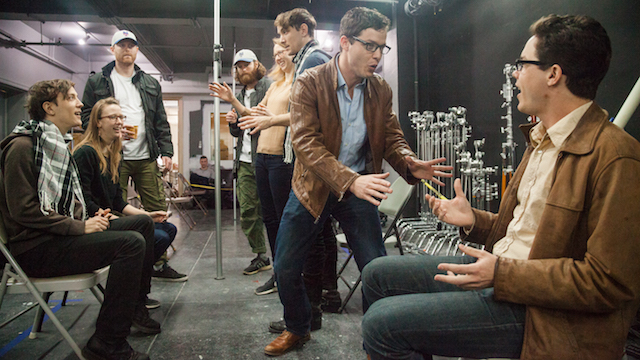
They then play randomly assigned improv roles. They could be former lovers, long-lost cousins, or undercover agents. Could be anything. Then they play their unlikely roles totally straight-faced, for as long as they like.

I once lived in a backpacker hostel with lots of long-term residents. I was chatting with a newcomer, and a friend asked me “who’s your friend” and I made an impromptu lie – she is my sister. We were both from NZ but that was the only commonality. It was accepted by everyone, for months. And it was a fun little inside joke. Until we drunkenly pashes one night and the truth had to come out, and many people refused to accept that we weren’t related.

This is a powerful and subversive concept, and therefore I figure it will certainly become a thing in the near future. And if it doesn’t, I’ll start it.